Headless or Standard WordPress for Swiss Publishers? Start with the Editor Preview
A decision guide for publishers choosing an architecture based on their publishing workflow rather than the appearance of the front end alone.

In this article
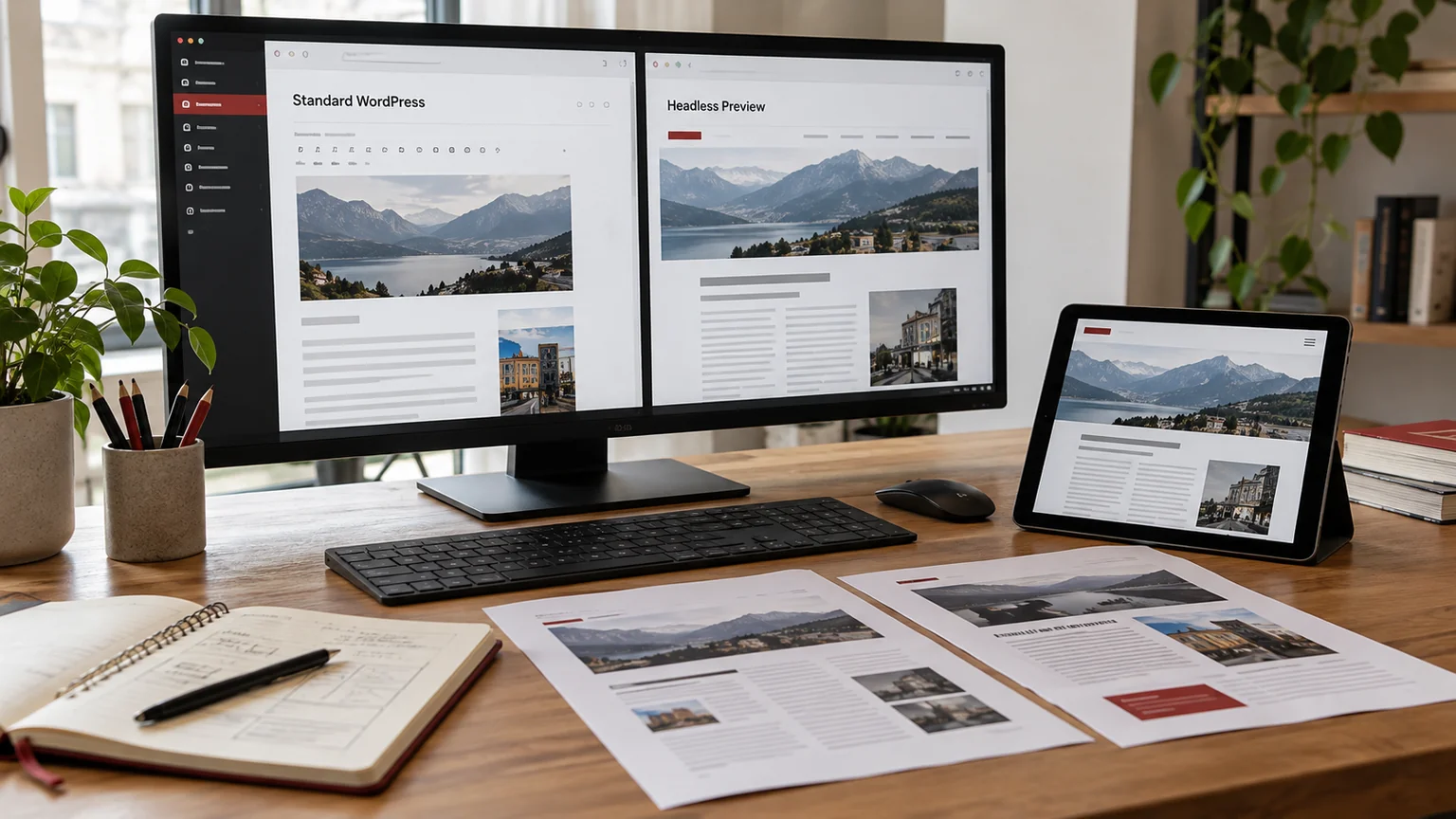
Illustrative workspace. Screens show concepts, not a delivered client system.
A headless WordPress website can look attractive in a technical proposal, but the editor still needs to preview an unpublished article, schedule a correction and understand what is live. For a Swiss publisher or content team, those everyday tasks are a useful starting point for comparing a conventional WordPress implementation with a separate React or Next.js front end.
Write the editor’s normal publishing sequence
Follow one article from draft through review, preview, publication and correction. Include images, related content, metadata and any language counterpart the publisher actually uses. Identify the person who approves each step and the information they need to see.
A conventional WordPress front end and a separate application do not automatically deliver the same preview experience. Ask for a demonstration of the actual workflow in the proposed architecture, with unpublished content and representative page components.
Make private preview a first-class requirement
WordPress’s REST API authentication documentation distinguishes public access from requests that need authentication. A headless preview must be designed around the content and permissions involved rather than exposing drafts as public data.
Define who can open a preview, how the preview chooses the intended revision and how it stays separate from the live page. The business reviewer should be able to confirm the layout without understanding a developer’s local environment. Access and expiry arrangements belong in the implementation scope.
Compare content flexibility with component support
List the layouts editors can create using approved controls. A separate front end may require a renderer for each supported block or structured component. If an editor adds an unsupported element, define what happens instead of allowing a broken page to become the first warning.
Where the requirement is a straightforward editorial site with native Elementor editing, a conventional build may be the more suitable option. Where a separate application has a clear product purpose, assess the extra component and preview responsibilities explicitly. Neither architecture should be selected on a performance promise alone.
Review live delivery and search pages
Include article archives, categories, search, feeds and any personalised areas in the comparison. Ask how a correction reaches the live front end and how the team can verify that it has arrived. Caching and rebuilding need a clear operating process.
Map current addresses and search signals before a rebuild. Check one real category journey and a paginated archive, not only a polished article detail page. The objective is a usable publishing system with reviewable delivery, not simply a successful API response.
Price the ongoing responsibilities
A proposal should identify who maintains WordPress, the front-end application, dependencies and deployment. Include the process for preview failures and urgent corrections. The publishing team needs a usable contact route and a clear owner for each part of the system.
| Review question | Evidence to request |
|---|---|
| Can editors preview? | An unpublished representative article |
| Can they correct content? | A reviewed change reaching the live page |
| Can they use supported layouts? | A documented component example |
| Can the system recover? | An agreed release and recovery process |
Should every publisher go headless? No. Choose it where the application requirements justify the additional responsibilities and the editor workflow has been demonstrated.
For the wider implementation decisions, see the WordPress API integration guide.
Discuss a scoped implementation
Share the current publishing workflow, representative layouts and the reason for considering a separate front end. I can assess the WordPress and React/Next.js scope and identify a useful prototype before a full rebuild.
I’m Jagjeet Singh, based in India and working remotely with businesses and agencies. Discuss your publishing architecture. Share the current site or workflow and the first outcome you want to review; I can assess the requirements and propose an implementation scope.
Written by
Jagjeet Singh
Full stack development, WordPress engineering and practical web products. I work with businesses, teams and agencies in India and worldwide.
Explore my work