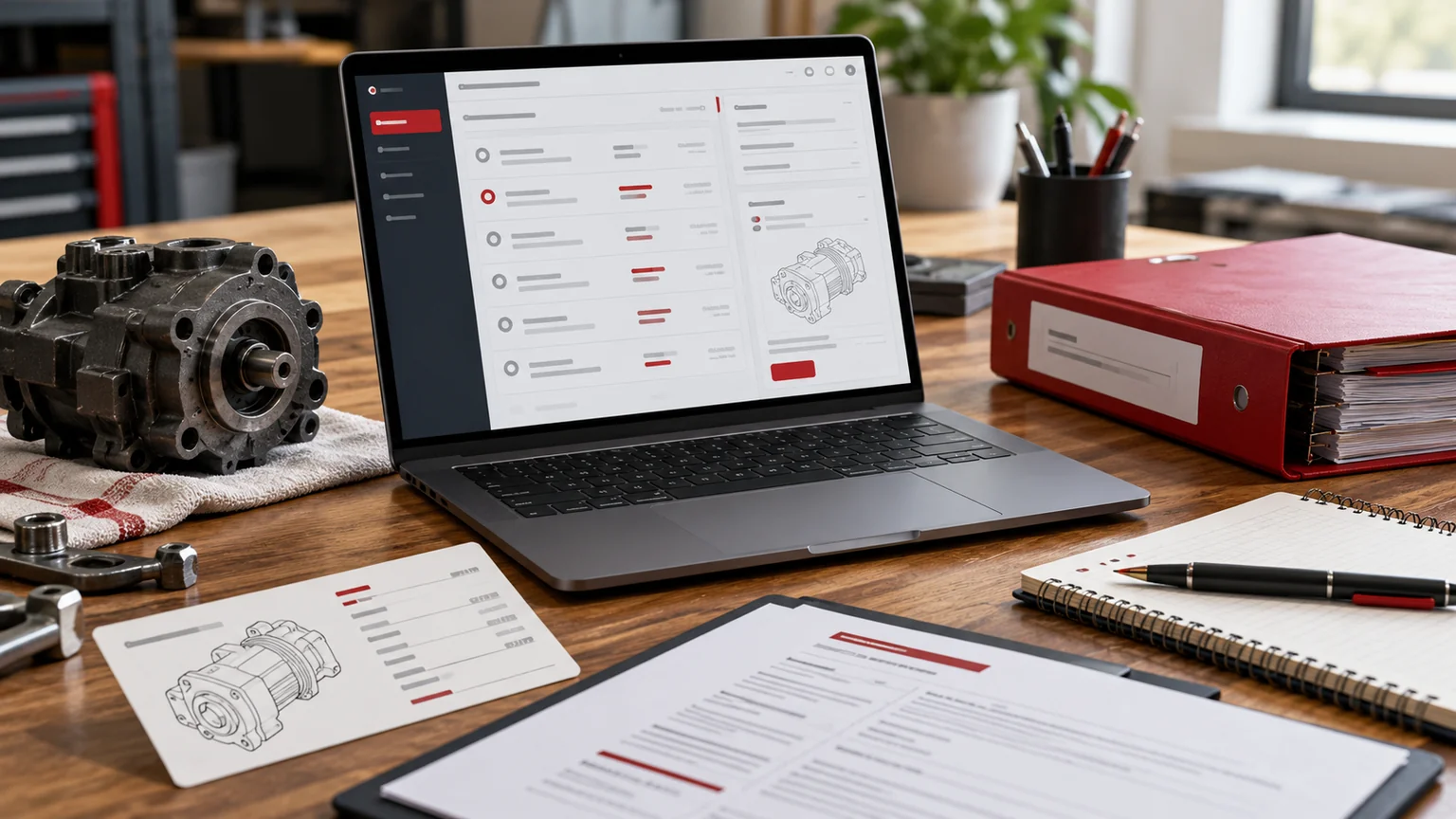
Illustrative workspace. Screens show concepts, not a delivered client system.
A dealer may submit a warranty request with a photograph and a product name, while the service team needs the equipment reference, issue history and the right supporting information. For Missouri manufacturers considering custom CRM development, the first opportunity is often a clearer intake and review process. The system should help staff assemble a useful case and track the next action. It should not quietly treat an incomplete submission as an approved warranty claim.
Define the request before designing the dashboard
List the information that the reviewing team needs to identify the product and understand the reported issue. Separate the dealer, end customer and equipment relationships. Decide which details the dealer supplies and which should be looked up in an approved internal source.
Missouri’s manufacturing information from MERIC provides sector context. This development guide focuses on a specific operational workflow, not a claim that every manufacturer has the same warranty process or that a particular business has commissioned the system.
Collect evidence without making the dealer repeat everything
Connect uploaded material and follow-up questions to a single case reference. If a reviewer asks for another photograph or a missing installation detail, the reply should extend the existing case rather than create an unrelated new enquiry.
Use only the evidence and contact details the business has approved. Define who may retrieve attachments and how long they remain available. A concept screen or prototype should use fictional records and should be labelled accordingly; real dealer files require an agreed handling arrangement.
Keep eligibility and remedy decisions explicit
The manufacturer owns its warranty terms, inspection requirements and decision authority. The CRM can record which terms and evidence were reviewed, but it should not invent an eligibility rule from the wording of an incoming message. Any automation needs a separately approved scope.
Useful statuses might distinguish awaiting information, technical review, decision recorded and fulfilment follow-up. Adapt those to the actual process. A customer-facing message should not imply that replacement, repair or reimbursement is approved simply because the request was saved successfully.
Link the decision to the next operational task
An approved action may involve parts, a return, dealer labour or an inspection. Identify the system that owns each task and the reference the CRM needs. A handover should be visible to the reviewer even when the downstream system is not controlled by the development team.
| Stage | Question for the implementation brief |
|---|---|
| Intake | Can staff identify the exact product and request? |
| Evidence review | What is missing and who must provide it? |
| Decision | Who approved the action and on what basis? |
| Handover | Which team or system owns the next task? |
Keep failed transfers and unresolved requests visible. A long list of nominally closed cases is not a substitute for a usable follow-up process.
Choose the pilot around difficult cases
Commission a small representative set: an incomplete request, a duplicate, an additional-evidence reply and a decision needing downstream action. Agree how the team will review the prototype before importing real records or connecting production systems.
Does this replace an ERP or service platform? Not necessarily. It can be scoped as a focused intake and coordination layer where a supported existing tool does not cover the gap. The manufacturing CRM planning guide provides broader context for related sales and dealer records.
Discuss your implementation
Share anonymised dealer requests, your current service tools and the review stages your staff actually use. I can assess a custom CRM workflow for your Missouri manufacturing team, with decisions and system boundaries defined before development.
I’m Jagjeet Singh, an India-based developer working remotely with businesses and agency teams. Discuss your manufacturing CRM implementation. Share the existing website or workflow and the decisions holding the project back. I can assess the requirements, recommend a suitable implementation approach and propose a defined scope. Working hours and review milestones can be agreed with your team.