Multilingual WordPress for Swiss Businesses: Separate Language from Country Targeting
A commissioning guide for choosing the language and market structure a Swiss business actually needs, without multiplying unnecessary pages.

In this article
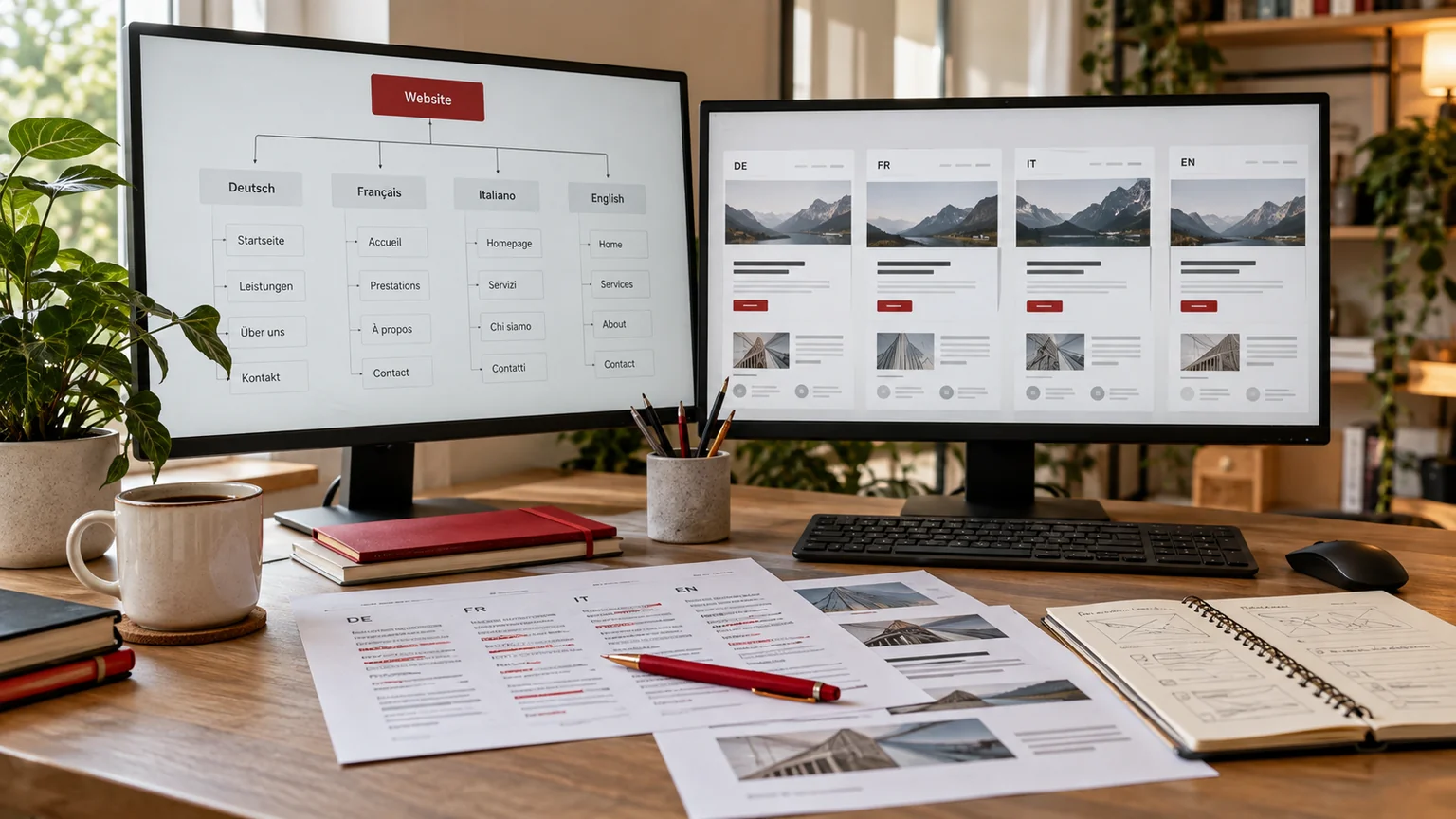
Illustrative workspace. Screens show concepts, not a delivered client system.
A Swiss business may serve several language audiences without needing a separate website for every language-country combination. Before commissioning multilingual WordPress development, distinguish what changes because of language from what changes because the commercial offer serves another market. That decision affects the content inventory, navigation, publishing effort and technical structure you are paying to maintain.
Draw a language and offer matrix
List the audiences your business intends to serve and the languages it can maintain with approved copy. German, French, Italian or English may be relevant choices, but your audience and service determine the actual scope. Do not create all combinations simply because they are possible.
Then identify genuine offer differences: service availability, contact team, catalogue or approved commercial information. A translation of the same offer and a distinct market offer should not be treated as identical content-planning problems.
| Question | Planning consequence |
|---|---|
| Only the language changes | Connected language versions may be sufficient |
| The offer also changes | Define the specific market content |
| No counterpart exists | Provide a deliberate navigation fallback |
| No content owner is available | Reconsider that launch scope |
Choose addresses before importing content
Google’s multiregional and multilingual guidance distinguishes language and region annotations and recommends separate URLs for language versions. The useful project decision is which versions genuinely exist and how their relationships will be represented.
Agree a readable address convention and preserve valuable existing destinations where possible. If the structure changes, prepare a specific redirect map. Do not send every old language URL to the new homepage and assume the visitor will find the right service again.
Define language switching at page level
A switcher should reach the appropriate counterpart of the current page when one exists. Where the offer or content differs, decide whether the visitor sees an alternative or a clear explanation. Test product pages, downloads and contact routes as well as the homepage.
Avoid making the visitor’s location the only basis for choosing language. A person can live in one market and prefer another language. An explicit choice also gives reviewers a reliable way to inspect the intended version.
Keep the content model manageable
Use shared components where they help preserve design consistency, while allowing approved language differences. A translated button can require more space; a legal or commercial statement may need separately approved wording. The brief should identify those responsibilities before the page layouts are signed off.
For a business selling online, SECO’s SME ecommerce overview emphasises choosing the business model and strategy before implementation. The same principle applies here: the technical language structure should support the actual offer, not determine it.
Review a complete visitor and editor journey
Choose one important service journey and follow it through navigation, page content, form, confirmation and staff handover in every launch language. Ask the future editor to make a routine content change and show how the counterparts are reviewed.
- The correct page counterpart is reachable.
- Contact instructions match the intended team.
- Forms and errors use approved language.
- The editor understands shared changes.
- Missing translations have an explicit status.
Must we launch every language together? No. An agreed staged release is often clearer than publishing incomplete versions. The business should approve which audiences the first release can serve properly.
For the wider implementation decisions, see the WordPress redesign planning checklist.
Discuss a scoped implementation
Send your current website, intended language audiences and any genuine differences between market offers. We can scope a representative page and its counterparts before committing to the wider content inventory.
I’m Jagjeet Singh, based in India and working remotely with businesses and agencies. Discuss your multilingual WordPress site. Share the current site or workflow and the first outcome you want to review; I can assess the requirements and propose an implementation scope.
Written by
Jagjeet Singh
Full stack development, WordPress engineering and practical web products. I work with businesses, teams and agencies in India and worldwide.
Explore my work