Multilingual WordPress for Luxembourg Businesses: Release Translations Without Content Drift
A publishing-process brief for keeping approved language versions aligned as a business website changes after launch.

In this article
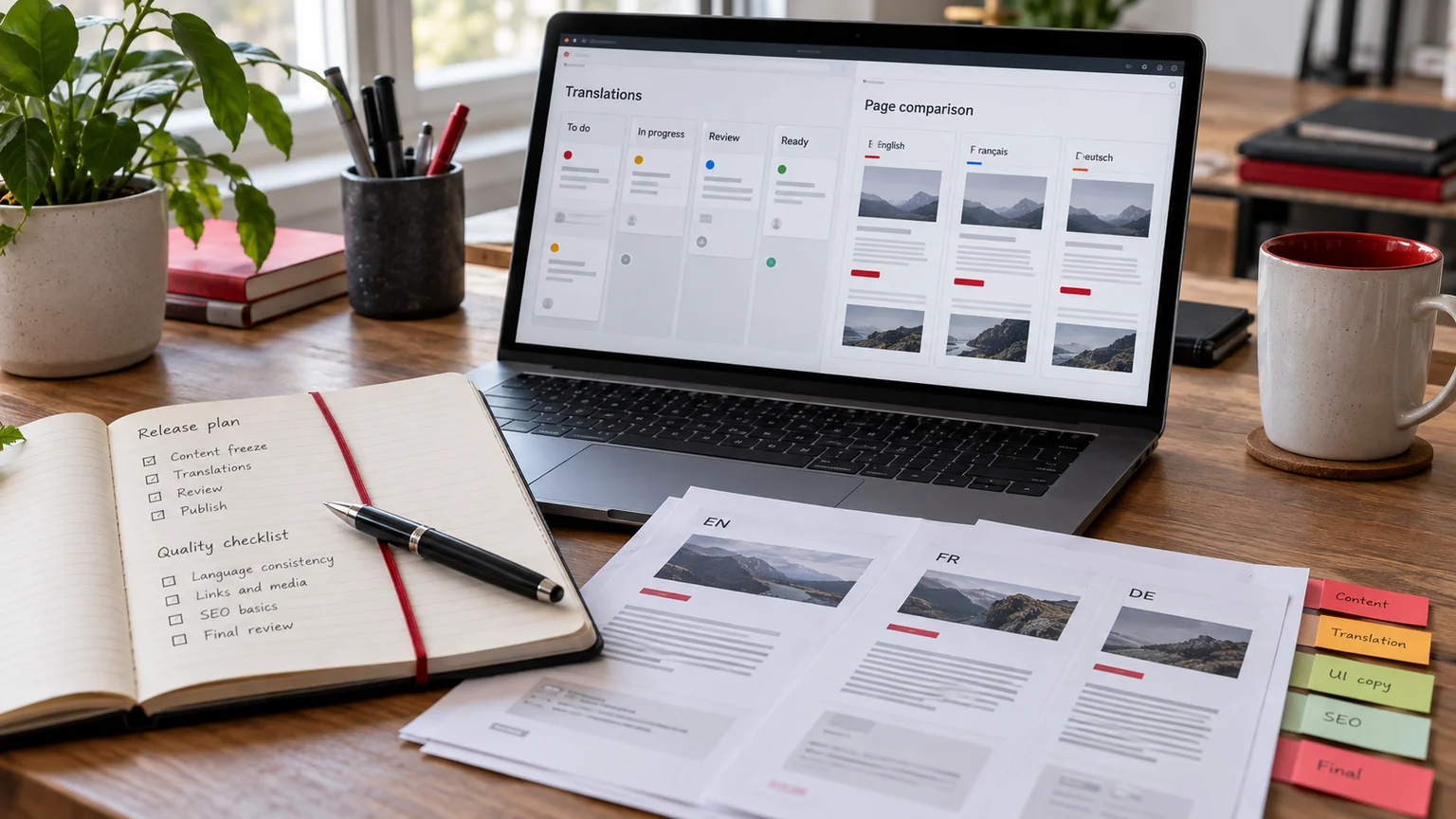
Illustrative workspace. Screens show concepts, not a delivered client system.
A multilingual website can begin consistently and drift as teams update one language faster than another. For a Luxembourg business commissioning WordPress work, the ongoing publishing process deserves as much attention as the first translated pages. The goal is to show which content is current, which counterpart needs review and who can approve the next release.
Assign language ownership before the build
Choose the languages your business can support with approved content and a responsible reviewer. French, German, English or another language may suit the audience, but the actual scope should follow your business rather than an automatic list of national languages.
Luxinnovation’s business-support FAQ discusses several digitalisation routes, including website-related support. This article is an independent technical commissioning guide, not an approved-provider or funding claim. The useful development starting point is the content process your team can maintain.
Record who owns the original, each counterpart and the final publication decision.
Define what a change makes out of date
A spelling correction and a changed service commitment may need different review. Decide which changes mark a counterpart for attention and how that status is shown to the editor. Avoid a workflow that silently publishes old translated wording beside a newly changed offer.
Keep enough reference information to explain which source version a translation was reviewed against. A page-modified timestamp by itself may not show whether the commercial meaning was checked. The client supplies the language judgement; the system makes the responsibility visible.
Control shared sections deliberately
Navigation, footer content and repeated contact sections may appear in many pages and languages. Identify which parts are shared and how a change reaches the relevant counterparts. A page-specific approval should not accidentally authorise a site-wide wording change.
Use native Elementor components and shared site parts for the agreed editing model. Show the editor a normal global change and its consequences. Where a language needs a controlled layout variation, record that decision so future updates preserve it.
Choose a publication policy for incomplete counterparts
Agree what happens when the original is approved before its translations. Options may include a staged release, a clearly controlled previous version or holding a change until the required counterparts are ready. The business should choose based on the content, not leave the outcome to accidental editor behaviour.
Test language-switching destinations when a counterpart is missing or unpublished. A switcher that silently opens unrelated content makes the publishing state harder for a visitor to understand. Keep page relationships and public availability explicit.
Review the update cycle after the first launch
Ask the team to change a service paragraph, revise a shared contact label and replace an approved image. Follow the change through review and publication in the required languages. Confirm the owner can identify what still needs attention.
- Each launch language has an owner.
- Changed source content is identifiable.
- Shared components have deliberate review rules.
- Incomplete counterparts follow an approved policy.
- Editors can demonstrate the update process.
Does multilingual tooling remove translation review? No. It can support the workflow, while the business remains responsible for approved language and accurate service information.
For the wider implementation decisions, see the WordPress redesign planning checklist.
Discuss a scoped implementation
Send the current site, launch languages, content owners and an example of a recent change. We can scope the Elementor structure and translation-release process around your Luxembourg team’s actual publishing work.
I’m Jagjeet Singh, based in India and working remotely with businesses and agencies. Discuss your multilingual publishing workflow. Share the current site or workflow and the first outcome you want to review; I can assess the requirements and propose an implementation scope.
Written by
Jagjeet Singh
Full stack development, WordPress engineering and practical web products. I work with businesses, teams and agencies in India and worldwide.
Explore my work