White-Label Elementor for Irish Agencies: Reusable Sections Clients Can Safely Edit
An agency delivery brief for building reusable sections while preserving the content controls the end client actually needs.

In this article
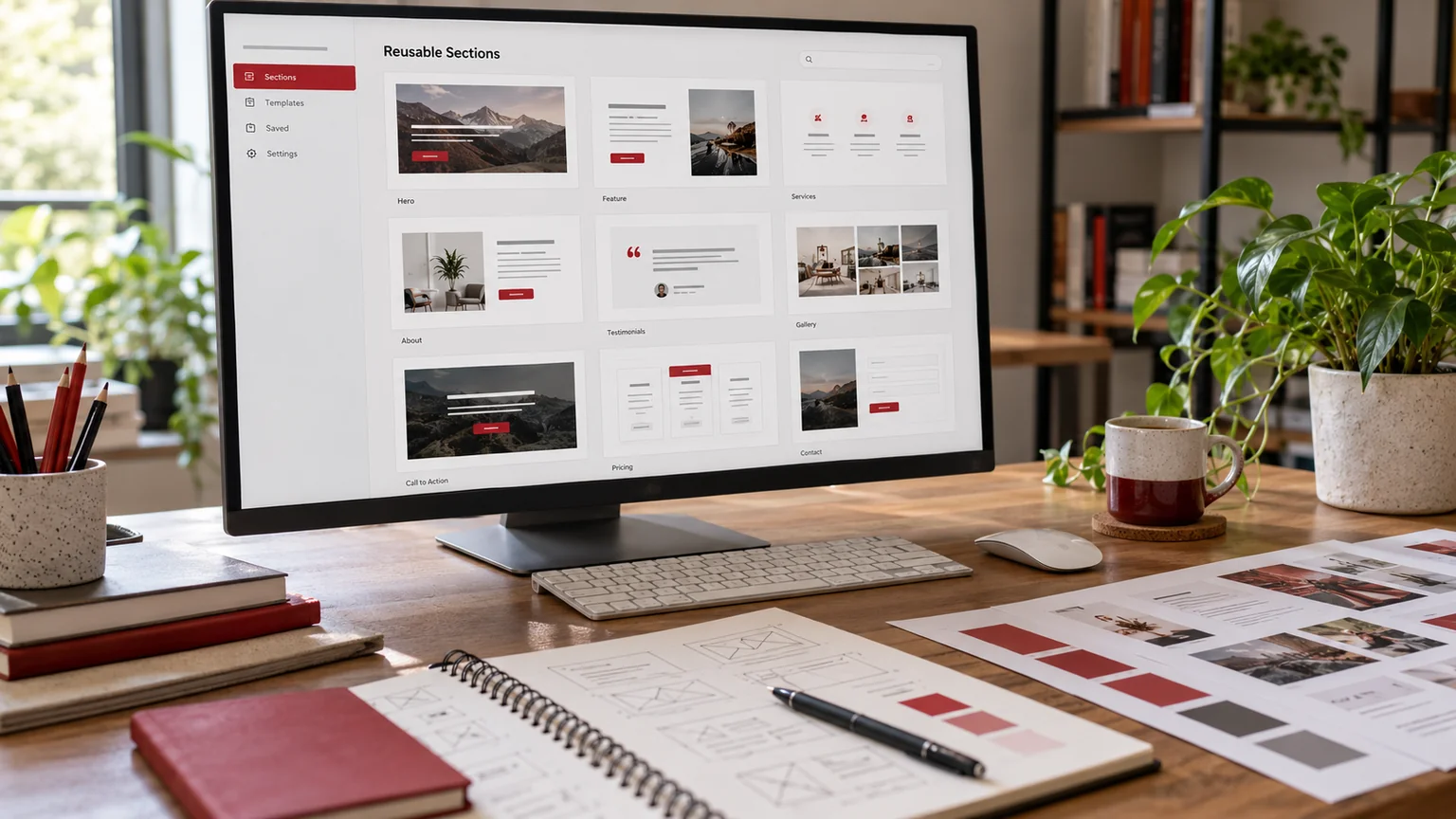
Illustrative workspace. Screens show concepts, not a delivered client system.
A reusable website section saves an agency time only if the client understands what can be changed and where the change appears. For an Irish agency outsourcing Elementor development, the handover should distinguish shared site components from page-specific content. That avoids a routine heading edit unexpectedly changing several pages, or an editor needing developer help for every small update.
Mark shared and local content in the brief
List the repeated sections in the design and classify how each should behave. A site-wide contact banner may be shared; the heading and example inside a service card may need page-specific content. Visual similarity alone does not determine the editing relationship.
Give the developer a representative design and real content. Record which styles are global and which variations are approved. The first review should establish the pattern the rest of the build will follow, rather than leave every page to an independent interpretation.
Choose native editing controls for ordinary content
Use appropriate native widgets and containers for the client’s routine marketing content. Define the controls needed for text, images, links and repeatable items. Avoid hiding a page’s ordinary copy in opaque HTML when the project promises Elementor editing.
Elementor’s Role Manager documentation describes options for limiting editor access. Assess those controls against the installed plan and the intended workflow. A permission setting does not replace a demonstration of what the client can safely change.
Review a component where it is actually used
Test the same section with a short title, long title, missing optional image and different button wording. Review narrow mobile as well as desktop. A component that works only with the design file’s exact text may not be ready for client editing.
Check a shared change across its intended pages. Then make a local change and confirm it remains local. Keep a short record of those behaviours so the agency can explain the system during handover.
Keep agency review separate from client approval
Agree the agency’s implementation review, the client content review and the person who authorises release. Feedback should identify the component or page, viewport and expected result. A consolidated review is easier to act on than contradictory notes in several channels.
Define how a new design request changes scope. Correcting a component to match an approved pattern differs from adding a new pattern after rollout. A clear checkpoint protects the delivery schedule and gives the client an understandable decision.
Deliver a useful maintenance handover
Provide the component list, editing examples and ownership of licences, access and ongoing support. Show the client how to make a realistic update and when to ask for help. The agency should retain the project references needed for future maintenance.
- Shared and local sections are identified.
- Global styles are consistent.
- Representative content variations have been reviewed.
- The client can perform routine edits.
- Release and future support owners are named.
Can delivery stay under our agency brand? A white-label arrangement can be agreed, including communication and handover responsibilities. Define it before implementation begins.
For the wider implementation decisions, see the agency design handover checklist.
Discuss a scoped implementation
Send a representative design, repeated-section inventory and the editing tasks your client needs. I can assess a scoped white-label build and review milestones for your Irish agency.
I’m Jagjeet Singh, based in India and working remotely with businesses and agencies. Discuss your agency Elementor build. Share the current site or workflow and the first outcome you want to review; I can assess the requirements and propose an implementation scope.
Written by
Jagjeet Singh
Full stack development, WordPress engineering and practical web products. I work with businesses, teams and agencies in India and worldwide.
Explore my work