WordPress Multisite vs Separate Websites: A Planning Guide for Growing Businesses
A commissioning guide for organisations weighing shared WordPress infrastructure against independent sites, teams and release responsibilities.

In this article
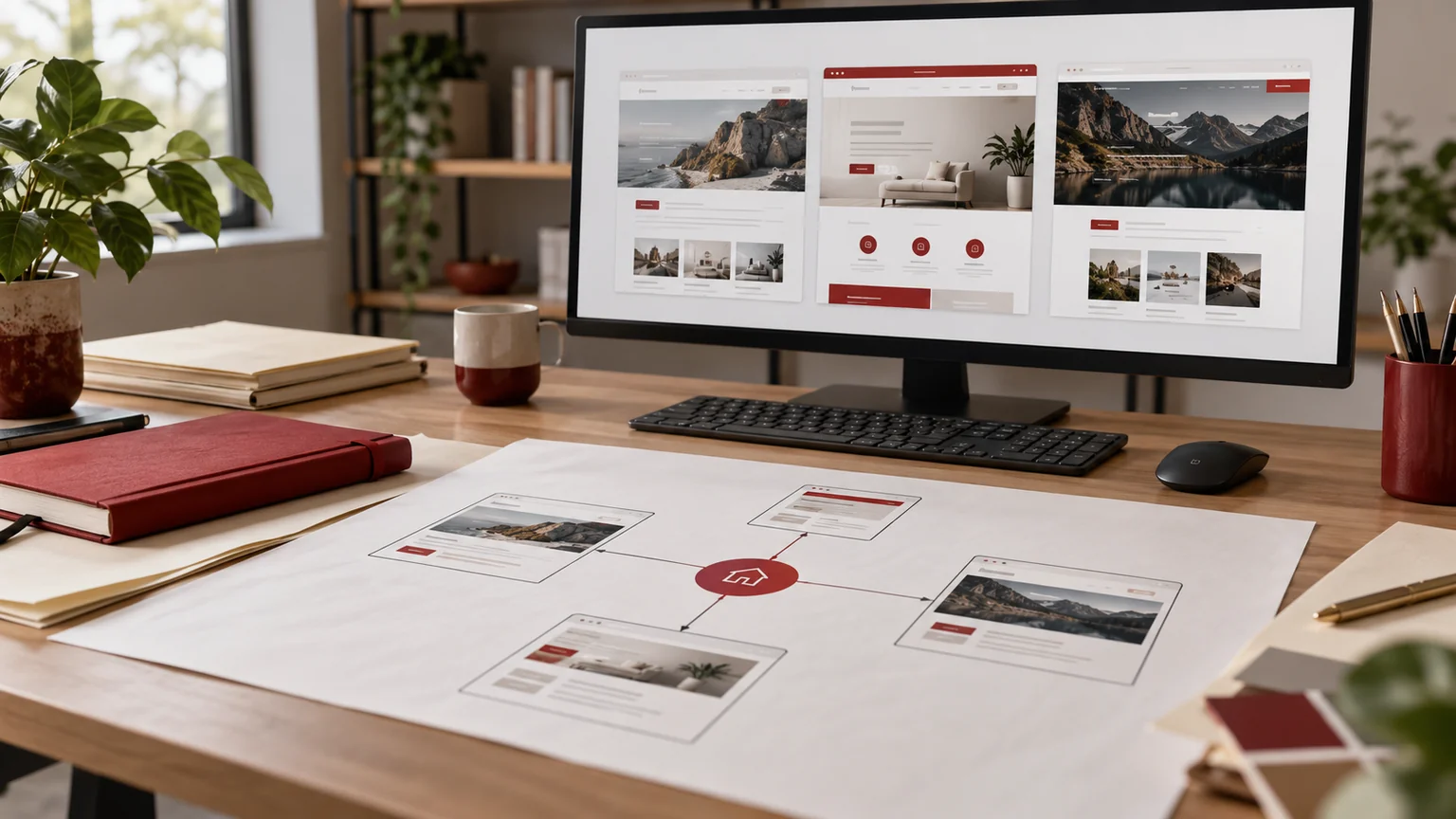
Illustrative workspace. Screens show concepts, not a delivered client system.
A business expanding into new brands, offices or regions may want several websites with a consistent design. WordPress Multisite is one option, but the number of sites is only part of the decision. Ownership, content differences, integrations and release responsibilities determine whether a shared network makes practical sense.
I’m Jagjeet Singh. My enterprise WordPress development service is offered around an assessed implementation scope, including the editing and operational responsibilities your organisation needs. This guide helps you prepare a multi-site brief before choosing between a network and separate WordPress installations.
Understand what a WordPress network shares
WordPress Multisite uses a common WordPress installation for a network of sites. Themes and plugins are managed through the network, with responsibilities that differ from those of an ordinary site administrator. The official Multisite administration guide explains the network management model.
Sharing an installation does not automatically create a content syndication system. If a head office wants to publish one announcement across selected regional websites, define that behaviour separately. The same applies to shared customer records, search, translations and reporting. A network provides an architecture; your workflow still needs a specification.
Map which decisions are central and which are local
List the people who approve branding, publish content, manage integrations and release updates. A common design may suit all locations while each local team needs to own offers, opening hours and contact details. Write down which decisions require central approval and which should be delegated.
- Global design components and the permitted local variations.
- Content types, languages and publishing roles for each site.
- Forms, CRM destinations and third-party integrations.
- The owner of hosting, backups, update testing and incident response.
WordPress’s roles and capabilities documentation distinguishes site and network-level permissions. Define the actual access matrix in the brief instead of promising each regional editor unrestricted control.
Compare operational coupling, not just convenience
A common codebase can support central control, but changes to shared components need a network-aware test and release plan. Separate installations allow independent decisions, while requiring an explicit process if you want to keep the design and plugins consistent across them.
| Question | Network planning | Separate-site planning |
|---|---|---|
| Who approves shared code changes? | Define network ownership and representative site tests | Define each site’s release owner and shared standards |
| Do brands need different integrations? | Check compatibility with the network and local requirements | Assess integration needs and maintenance per installation |
| Will a brand become independent? | Plan how its content, users and dependencies could be separated | Plan ownership and account transfer for that installation |
| How is consistency maintained? | Agree shared templates and permitted site variation | Agree reusable design assets and a coordinated update process |
Neither structure removes the need for governance. If websites belong to unrelated customers or independent teams, that boundary should be part of the architecture decision.
Design an editing model before duplicating pages
Choose a representative site and establish its templates, reusable sections and content fields. With Elementor, define which page areas use native editable widgets and which shared templates are centrally maintained. If there are different editors, review the controls each person will actually use.
Do not solve consistency by copying a header into every page body. Shared site parts and clearly owned reusable content are easier to maintain. A local contact block, however, may need site-specific information. Identify those exceptions rather than forcing every website into a template that hides necessary differences.
A useful pilot includes a standard page, an unusual local page, a form and a global design update. Ask the relevant editors to perform ordinary changes before repeating the setup.
Assess plugin, hosting and recovery requirements early
Review the actual plugins, licences, domains and hosting configuration required for the proposed setup. Compatibility and licence coverage need checking against the intended network or separate-site arrangement; the presence of a plugin on one site does not establish that it fits every deployment.
Agree backup and restore granularity. Your team should know what happens when one site needs recovery, which records are affected and how other sites remain protected. Add monitoring, access review and update testing to the maintenance scope. If you are considering WordPress VIP or another managed platform, hosting acceptance, costs and platform-specific requirements need their own assessment. A development proposal does not by itself imply certified partner status.
Clarify the common commissioning questions
Is Multisite always better once we have several websites? No. Shared ownership and compatible requirements can make it useful, while independent product roadmaps may justify separate installations. The decision needs your actual site and team inventory.
Can each site have its own content? Yes; decide how that content is managed and which items, if any, should be shared through an additional workflow.
Can we change architecture later? Treat separation or consolidation as a migration project with content, domains, users and integration checks. Avoid assuming it will be a routine toggle after the websites are in production.
Prepare a multi-site development brief
Share your existing sites, planned brands or regions, languages, editor roles and key integrations. Explain what should stay consistent and what needs independent control. Include the person responsible for hosting and the expected release process.
The next step can be a scoped architecture review and a representative pilot, followed by an implementation plan based on the findings. My WordPress development service covers the website build discussion, while WordPress maintenance can be agreed separately for ongoing care. Discuss your multi-site requirements to turn the inventory into an editable and maintainable delivery scope.
Written by
Jagjeet Singh
Full stack development, WordPress engineering and practical web products. I work with businesses, teams and agencies in India and worldwide.
Explore my work