WordPress Plugin Reviews for German Businesses: Decide What to Keep, Replace or Rebuild
A commissioning guide for deciding whether an existing plugin, a supported replacement or a focused custom extension fits the business need.

In this article
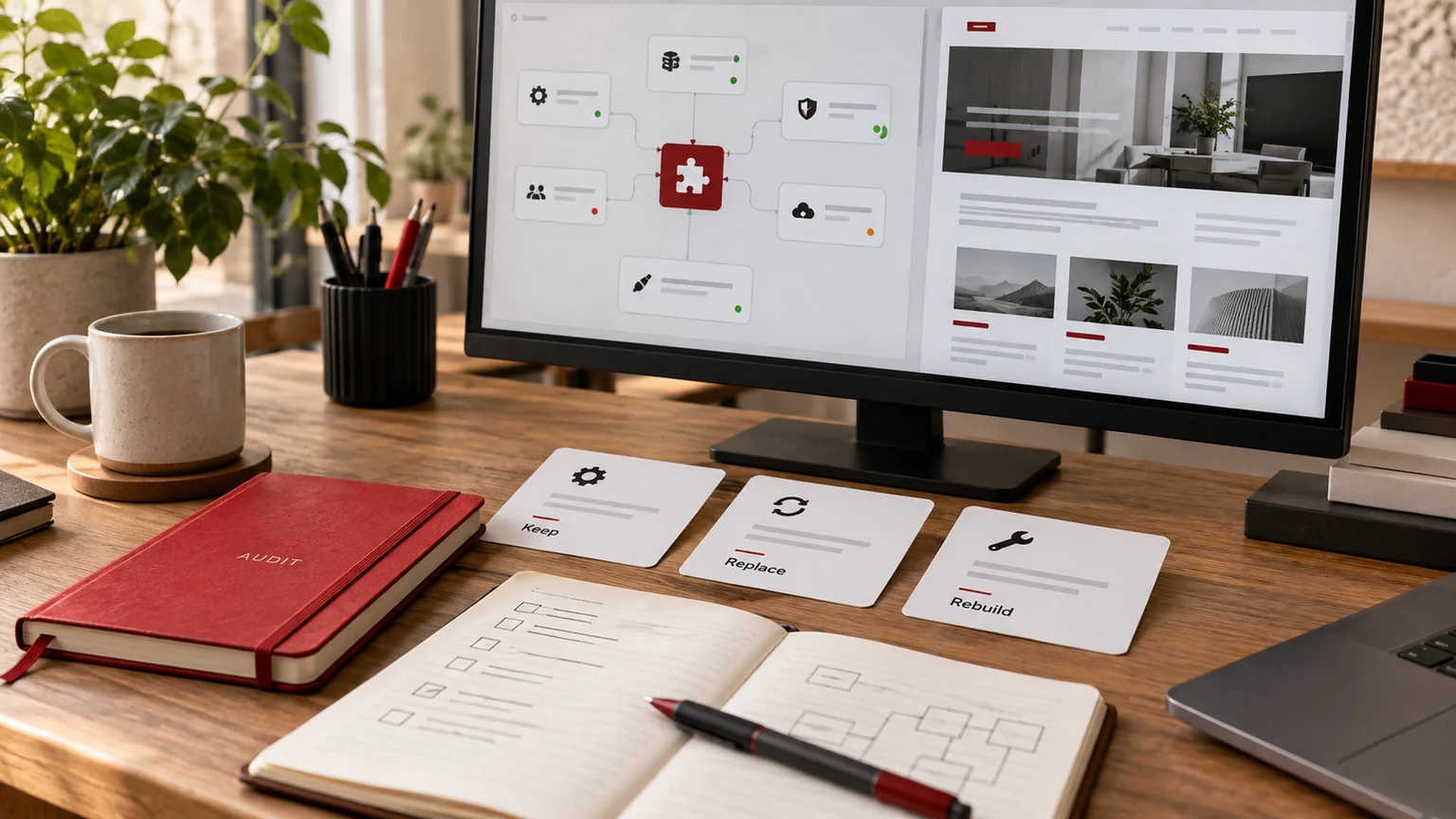
Illustrative workspace. Screens show concepts, not a delivered client system.
A long plugin list can make a WordPress site difficult to understand, but removing plugins purely to reduce a count can break useful business functions. For a German company considering a review, start with what each plugin does and who depends on it. The outcome should be a clear keep, replace or rebuild decision supported by evidence.
Map functionality to the business journey
List the visible features and less obvious jobs: forms, search, customer roles, redirects, scheduled tasks or data transfers. Identify the owner and the pages or tools that depend on each. A plugin with no obvious front-end widget may still support an important process.
Ask which functions the business still needs. Retiring unused behaviour can be simpler than replacing it. Record that as an approved decision so missing functionality is not discovered only after release.
Review dependencies before choosing a replacement
A theme, custom extension or integration may rely on a plugin’s fields or extension points. WordPress’s hooks documentation describes how code can interact at defined points. A replacement with similar marketing wording may not expose the same boundaries.
Inspect the connected data and operating process as well as the plugin settings. The review should identify migration work and maintenance ownership, not only compare screenshots of two feature lists.
Assess supported options against the actual gap
Check current vendor documentation, compatibility requirements and support arrangements for the tools under consideration. A suitable maintained extension may be preferable to custom code where it meets the requirement. A custom plugin makes sense where a specific gap justifies its ongoing responsibility.
Do not label a plugin vulnerable or unsupported without current evidence. Separate a verified issue from an architectural concern or a preference. The business needs an accurate reason for the proposed work.
Plan data and behaviour through the change
Define what happens to saved records, references and public destinations when functionality changes. A new form or catalogue tool may need existing data mapped into another structure. Deactivating the old plugin is not a migration plan.
Prepare a representative review in a suitable environment and agree rollback. Include the business journeys that use the function, not only the settings screen. Real emails, orders and external actions require authorised test arrangements.
Request a decision-focused report
A useful assessment names the function, current dependency, recommendation and work needed to implement it. Prioritise based on business impact and evidence. Avoid a proposal that replaces every tool without showing why the change serves the website.
| Decision | Reason to establish |
|---|---|
| Keep | The tool meets the requirement with a clear owner |
| Replace | A supported alternative fits and migration is assessed |
| Rebuild | A defined gap justifies custom maintenance |
| Retire | The business no longer needs the behaviour |
Will fewer plugins always make the site faster? No. The work each component performs and how it is implemented matter more than the count alone. Measure the relevant pages and journeys.
For the wider implementation decisions, see the custom WordPress plugin planning guide.
Discuss a scoped implementation
Send the website, the functions you rely on and the issue prompting the review. We can assess the dependencies before proposing a targeted repair, replacement or custom extension.
I’m Jagjeet Singh, based in India and working remotely with businesses and agencies. Discuss your WordPress plugin assessment. Share the current site or workflow and the first outcome you want to review; I can assess the requirements and propose an implementation scope.
Written by
Jagjeet Singh
Full stack development, WordPress engineering and practical web products. I work with businesses, teams and agencies in India and worldwide.
Explore my work