AI Workflow Automation for French SMEs: Route Incoming Documents to the Right Reviewer
A limited automation brief for preparing incoming documents for the right reviewer without treating classification as approval.

In this article
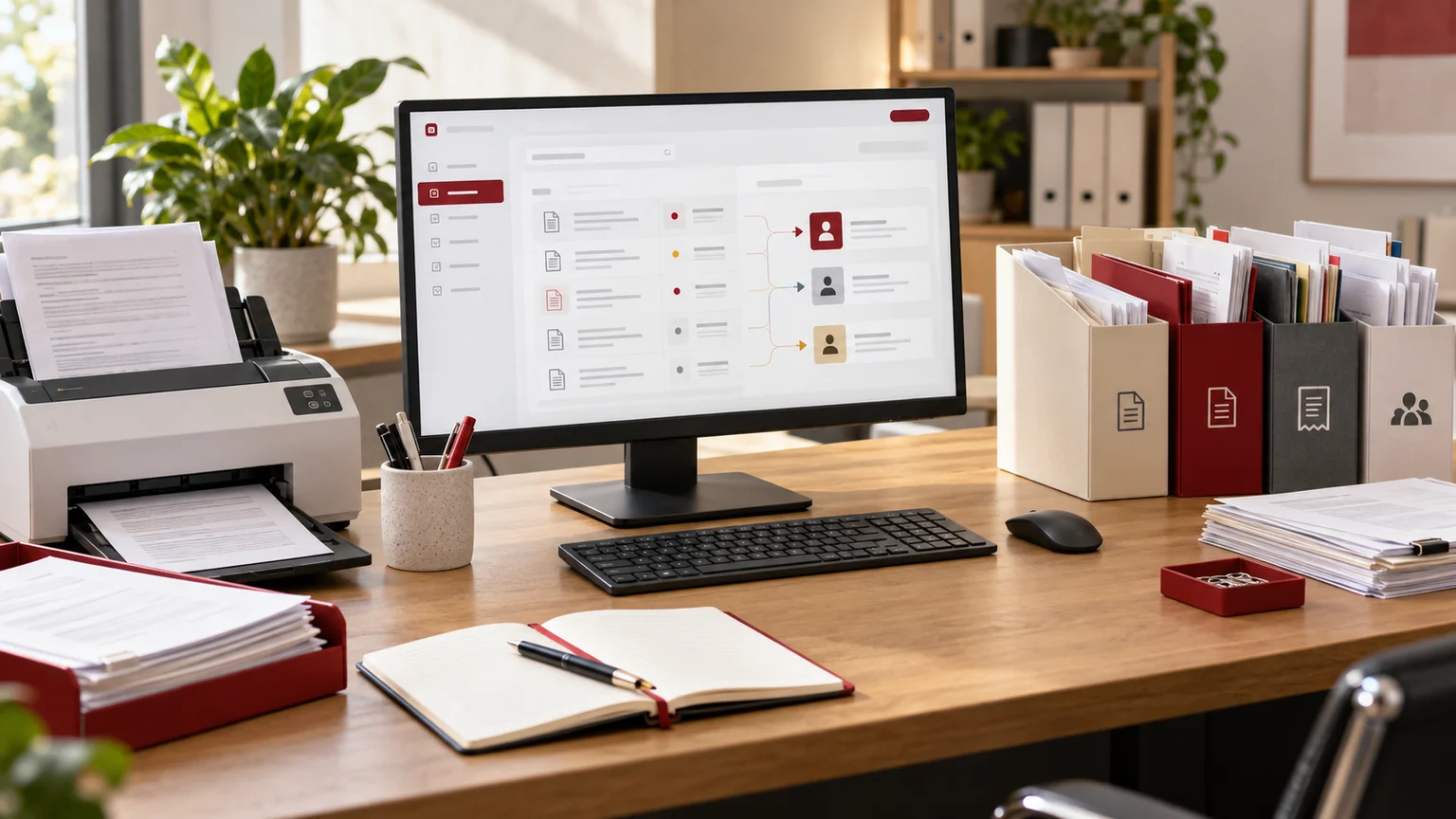
Illustrative workspace. Screens show concepts, not a delivered client system.
A shared inbox can contain requests, supporting documents and material that belongs to several departments. For a French SME, an AI-assisted workflow may help propose a document type and route it for review. The first pilot should make that suggestion traceable and keep uncertain cases visible, rather than let a classification silently authorise a business action.
Choose a small, defined document set
Start with a few document types the team already understands. Identify the source channel, responsible owner and required handling. The business supplies the permitted information and storage arrangements; an unrestricted mailbox import is not a necessary first step.
Prepare representative approved examples and a separate exception category. A document that does not fit should remain reviewable rather than be forced into the nearest label. Keep the pilot’s boundaries explicit.
Separate suggested classification from a decision
The assistant can propose a type or extract a reference, while the workflow records that result as a suggestion until the agreed review occurs. Preserve the source so staff can inspect why the system proposed a route.
Decide which missing or contradictory values require clarification. A fluent summary should not supply an invented customer reference, approval or instruction. The receiving team needs to see uncertainty rather than discover it after acting on a record.
Treat document content as untrusted input
OWASP’s prompt-injection guidance describes how external material can contain instructions that influence an AI system. Incoming documents should be treated as information to classify, not authority to change the workflow or execute unrelated actions.
Keep the assistant’s permissions limited to the assessed task and evaluate the actual boundaries. Retrieval and a carefully worded prompt do not eliminate every risk. A first triage pilot need not send messages, change account details or approve transactions.
Design an exception queue people can use
An uncertain item needs an owner, a reason for review and a next action. Avoid a queue that merely accumulates documents no one is responsible for. Let reviewers correct the classification through an agreed process without silently turning every correction into new production training data.
Record repeated submissions and supported reprocessing behaviour. The same incoming document should not create several independent operational requests simply because a transfer was retried.
Evaluate routing quality and handover together
Use fictional or approved sample documents for ordinary, ambiguous, duplicate and out-of-scope cases. Ask the receiving departments to judge whether the record is usable. A classification score alone does not establish that the business handover works.
- The proposed type remains distinguishable from approval.
- Source references are available to reviewers.
- Uncertain cases reach an accountable queue.
- Untrusted content cannot authorise actions.
- Repeated transfers do not duplicate work.
Can it automate more later? Potentially. Add each connected action only after its authority, supported interface and failure handling have been assessed.
For the wider implementation decisions, see the business workflow automation guide.
Discuss a scoped implementation
Describe the first document types, current receiving teams and desired review record. We can scope a limited AI workflow and its evaluation before connecting wider sources or operational actions.
I’m Jagjeet Singh, based in India and working remotely with businesses and agencies. Discuss your document-routing pilot. Share the current site or workflow and the first outcome you want to review; I can assess the requirements and propose an implementation scope.
Written by
Jagjeet Singh
Full stack development, WordPress engineering and practical web products. I work with businesses, teams and agencies in India and worldwide.
Explore my work