Framer vs WordPress for a Startup Website: Which Should You Commission?
A commissioning guide for startup teams choosing a website platform around publishing, integrations, future content and maintenance ownership.

In this article
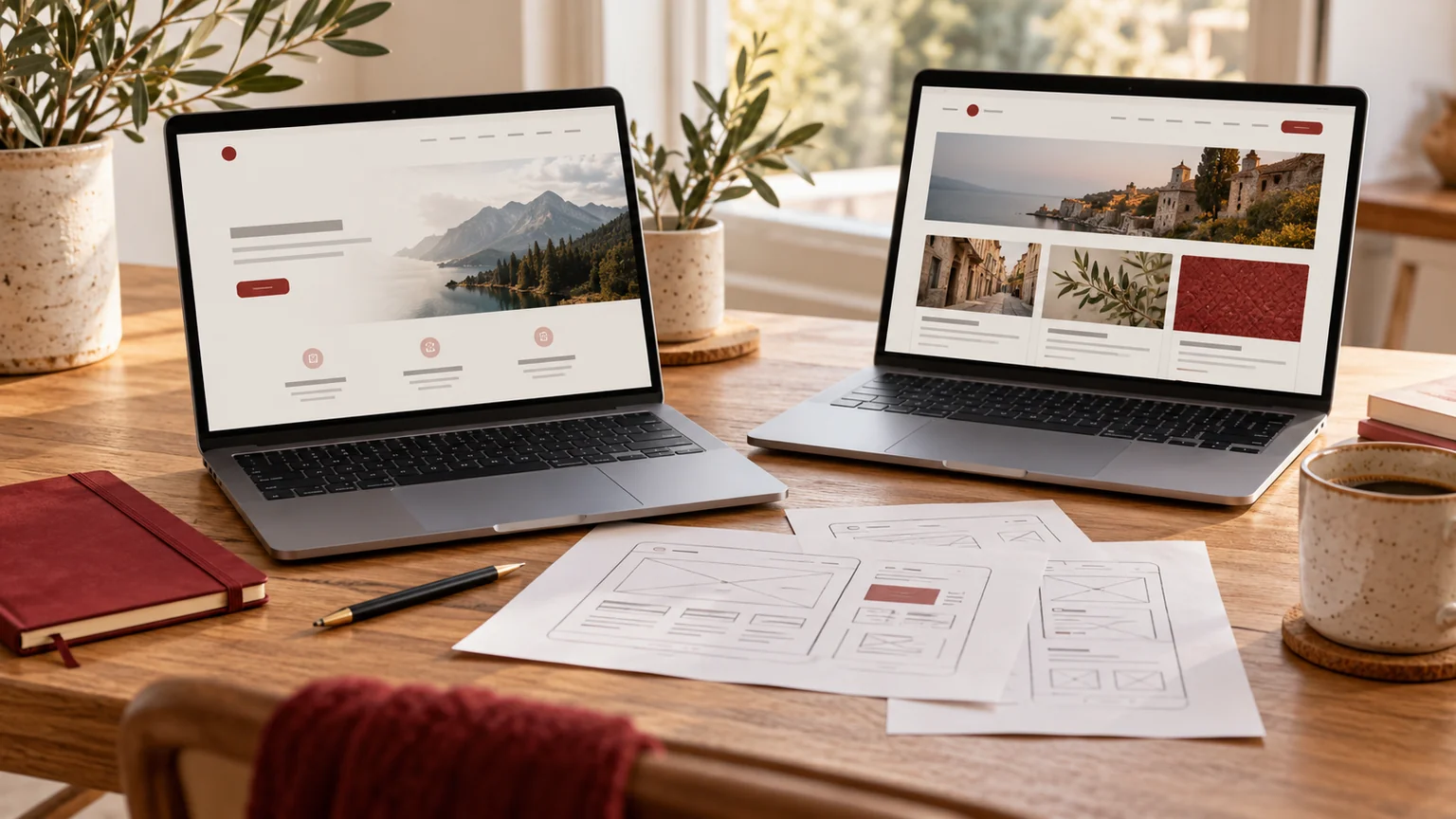
Illustrative workspace. Screens show concepts, not a delivered client system.
A startup may like a Framer design reference while needing the editing or integrations of WordPress. Another team may want a focused launch website maintained directly in Framer. The choice should start with who will use the website and what it needs to do after launch, rather than a platform name in the design brief.
I offer Framer website development and WordPress development, depending on the project. A Framer-like visual direction can also be implemented in WordPress when that is the agreed destination. This guide helps a founder or agency commission the actual platform and handover they need.
Write the website job before choosing the tool
Describe the journeys that matter: understanding the product, exploring use cases, requesting a demo, reading resources or submitting an enquiry. Identify who writes and approves the content and how frequently it will change. A launch page and a growing resource library may need different structures even when they share the same visual style.
- Page types, expected content and language requirements.
- The team members who will edit and approve changes.
- Forms, CRM, analytics and other connected systems.
- Design references, accessibility expectations and mobile journeys.
Treat future possibilities as a separate list from launch commitments. This helps the developer assess an architecture without turning every hypothetical feature into the first release.
Compare the publishing workflow your team needs
Framer supports website pages and CMS pages used for structured content. Its official page guidance explains the distinction between those page types. A proposal should specify the collections, fields and templates your content will use, rather than describing the whole site as a set of static screens.
For a WordPress implementation, agree the editing tools, content types and shared site parts. If Elementor is the intended editor, request native widgets and reusable templates with a demonstrated editing handover. Plugins, custom fields or additional code may be needed for particular requirements and should be visible in the scope.
Ask the person who will maintain the website to try an ordinary content edit in the proposed model. That is more informative than assuming one editor is universally suitable for every team.
Specify integration behaviour instead of listing logos
“Connect the CRM” leaves important questions unanswered. Decide which fields the form collects, how a submission reaches the destination, who owns it and what happens when a connection fails. Apply the same thinking to bookings, gated resources, newsletter signups or any other workflow.
For either platform, assess the actual integration approach and its constraints before committing to the full build. A third-party embed, supported integration or custom implementation can have different editing and maintenance implications. The website developer and the owner of the connected system should agree what will be tested.
Do not send production credentials in a website quote form. Begin with the public site or design reference and the names of the systems involved; access can be arranged for the approved assessment.
Turn visual references into an implementation brief
A polished reference shows a direction, not the complete scope. Identify the typography, spacing, sections and interactions you value, then define their behaviour on smaller screens. Avoid copying another business’s content or evidence into your startup site.
| Design reference | Requirement to specify |
|---|---|
| Animated hero | Motion behaviour, readability and reduced-motion handling |
| Reusable landing-page sections | Which areas editors can update or rearrange |
| Resource cards | Content fields, categories and destination templates |
| Demo request area | Required fields, validation and follow-up destination |
For a WordPress build inspired by a Framer design, make that platform choice explicit. A similar appearance does not mean a Framer project is being automatically converted into a native WordPress website.
Discuss ownership, content portability and ongoing care
A handover should identify account ownership, permissions, domain configuration, paid dependencies and the person responsible for ongoing changes. Compare the actual requirements and responsibilities in your proposal; avoid assuming one platform has no maintenance simply because its hosting arrangements differ.
Framer documents Markdown use in CMS rich-text content. This can be useful for working with article text, but content portability is not a promise that an entire website, design and integrations can be exported into another platform unchanged. If migration flexibility matters, specify the content and assets you expect to retain and how they will be delivered.
For WordPress, agree hosting, updates, licences and support ownership as part of the operating plan. The website proposal should separate those ongoing items from the initial design and build.
Choose a pilot when the important requirement is uncertain
A representative page can test the editing model, an interaction and a key integration before the rest of the website is commissioned. Define what that pilot must demonstrate and which questions it cannot settle. It should reduce a specific uncertainty rather than serve as a free-form design exercise.
Which platform is cheaper? Compare quotes for the same approved scope, including subscriptions, integrations and ongoing care. A generic platform comparison is not a project estimate.
Can we launch small and expand? Yes, if the content and template plan accounts for the intended next phase. Identify the dependencies that would change the architecture before accepting a very narrow launch scope.
Request a website proposal built around the right platform
Share your launch objectives, content inventory, design references and connected systems. Include who will edit the website, your review availability and any existing domain or hosting arrangements. For an agency partnership, explain the client handover and release responsibilities as well.
I can review the brief and scope a Framer build, a WordPress implementation or a focused assessment where a requirement needs testing first. Discuss your Framer or startup website requirements or review the website developer engagement page. The proposal should make the destination platform, editable deliverables and ongoing ownership clear from the start.
Written by
Jagjeet Singh
Full stack development, WordPress engineering and practical web products. I work with businesses, teams and agencies in India and worldwide.
Explore my work