Manufacturing CRM for Taiwan Suppliers: From Sample Request to Production Handover
A buyer guide to keeping the sample, its approved specification and the next commercial decision connected.

In this article
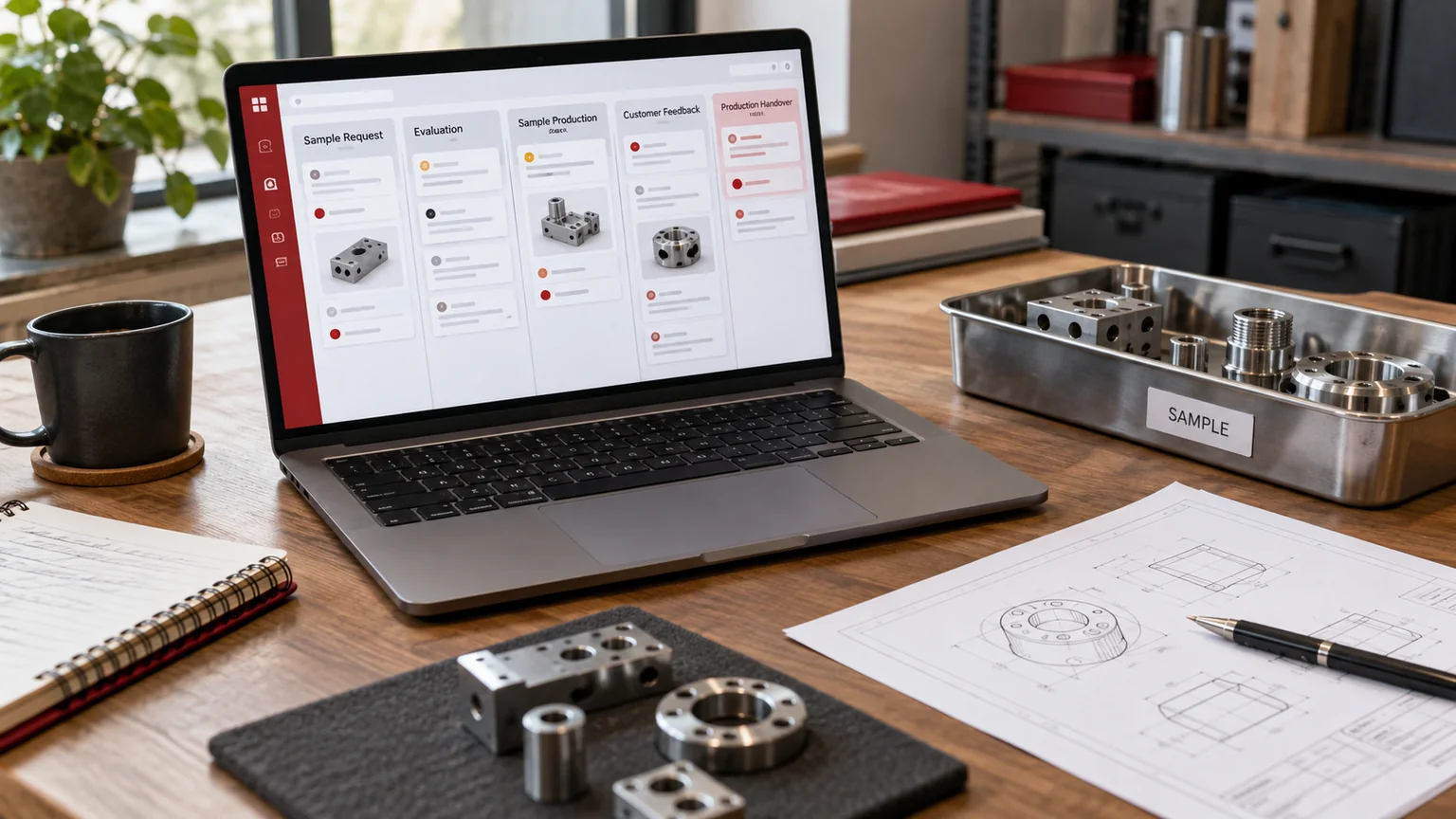
Illustrative workspace. Screens show concepts, not a delivered client system.
A sample request is often more than a lead with a contact name. The customer may revise a drawing, ask for another finish or review a second prototype before discussing production. For a Taiwan supplier, a manufacturing CRM project can start by making that sequence clear, so engineering and sales know which sample and decision are current.
Model the sample as its own record
Separate the customer, commercial opportunity and sample request. One customer may have several concurrent requirements, each with its own reference and history. A single contact note cannot reliably explain which product version the discussion concerns.
The sample record should identify the requested specification, responsible engineer, commercial owner and next review. Attach the approved reference to the event that used it. When a drawing is replaced, keep enough history to understand why the previous sample was produced; do not silently rewrite the past.
| Record | Purpose |
|---|---|
| Customer | People and company relationship |
| Opportunity | The commercial requirement |
| Sample | The specific requested version |
| Review | Feedback and agreed next action |
This is a proposed custom workflow, not a claim that a finished system already exists.
Define specification and attachment handling
Decide which drawings, photographs and documents the team may collect, where they are stored and who can see them. A public request form can gather an initial description; controlled project access may be more appropriate for proprietary drawings.
WordPress’s media API documentation describes attachments as records with their own identifiers and metadata. That is a useful architectural distinction if WordPress forms part of the solution. Uploading a file alone does not establish version ownership, approval or restricted access; those behaviours need an explicit implementation.
Keep physical dispatch separate from sample approval
Record the dispatch reference, destination supplied by the customer and the version sent. A delivery event means that a parcel reached its destination, not that the customer approved its contents. Use separate states and tasks for sending, receiving feedback and deciding the next step.
For a revised sample, link the new request to the previous review. Staff should be able to explain what changed and which requirements remain unresolved. The business supplies the terminology and commercial rules; the CRM implements the agreed record and responsibilities.
Prepare the production handover
Choose the conditions required before a request is ready for production review. They may include a confirmed specification, recorded feedback, agreed quantities and a responsible commercial decision-maker. Do not let an automated status change replace an approval the business requires.
The handover should point to the current approved records rather than copy a loose collection of email attachments. If an ERP receives the result, assess the supported interface and identifiers before including it in the proposal. A CRM can first create a reviewable task while a deeper integration remains a separately scoped phase.
Pilot exceptions as well as the normal sequence
Use fictional examples for a revised drawing, a lost reference, duplicate enquiries and feedback that arrives after a new sample is requested. Ask sales and engineering to review the same history and identify the next owner. If they disagree, resolve the workflow rule before expanding the system.
- Can the team identify exactly what was sent?
- Can it distinguish feedback from approval?
- Can it locate the current specification?
- Can it see the reason for a revision?
- Can it assign a production-review task without inventing an order?
Does this replace our ERP? It may support the pre-production workflow while your ERP remains authoritative for confirmed orders and operations. Start with that boundary.
For the wider implementation decisions, see the manufacturing CRM planning guide.
Discuss a scoped implementation
Describe the sample stages, current spreadsheets or tools, specification references and production handover. A few anonymised examples of revisions are more useful than a long list of generic CRM features when assessing the first implementation.
I’m Jagjeet Singh, based in India and working remotely with businesses and agencies. Discuss your sample-tracking CRM. Share the current site or workflow and the first outcome you want to review; I can assess the requirements and propose an implementation scope.
Written by
Jagjeet Singh
Full stack development, WordPress engineering and practical web products. I work with businesses, teams and agencies in India and worldwide.
Explore my work