Arabic and English WordPress Websites for Dubai Businesses: An RTL Development Brief
A commissioning guide for Dubai businesses that need Arabic and English journeys, reviewed layouts and a manageable WordPress editing workflow.

In this article
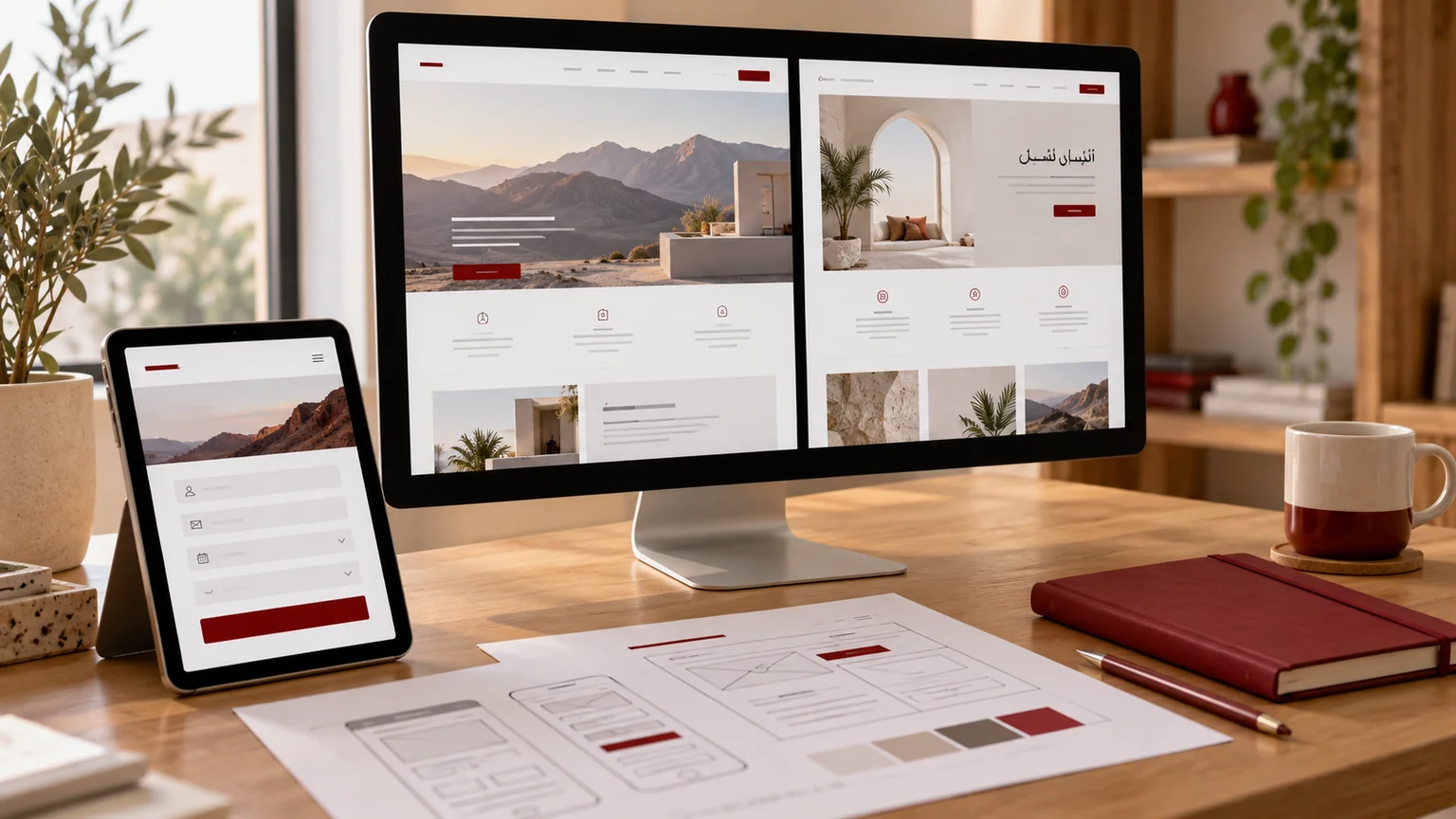
Illustrative workspace. Screens show concepts, not a delivered client system.
If your Dubai business needs Arabic and English website content, plan both visitor journeys before approving the build. Translation, right-to-left layout, language switching and form behaviour are related decisions. An English design with Arabic text added at the end may leave the second-language experience incomplete.
I’m Jagjeet Singh, an India-based developer working remotely with businesses and agencies. My WordPress development service can be scoped around a bilingual Elementor implementation, with approved language content and an Arabic reviewer supplied or arranged by the client. This guide helps you prepare the technical and publishing brief.
Choose which pages and journeys exist in each language
List service pages, articles, navigation, contact routes and confirmation messages. Decide whether every item has a counterpart or whether some content is intentionally available in one language only. A language switcher needs a defined destination when the corresponding page is missing.
Assign ownership of the English copy, Arabic copy and final review. The developer implements the agreed content and layout behaviour; translation approval needs a person who can judge the language and terminology. Record how later edits will reach both versions.
- Page inventory and language counterparts.
- Global navigation, footer and repeated sections.
- Forms, errors and confirmation messages.
- Content owners and the approval process.
Define language URLs and switching behaviour
Google’s multilingual site guidance recommends separate URLs for language versions and appropriate language annotations. It also recommends letting visitors choose a language rather than relying on automatic redirects. These are implementation inputs, not a promise of ranking positions.
Agree the URL structure before importing pages or changing important addresses. The switcher should reach the intended counterpart where one exists and show the approved fallback where it does not. Check links inside page content as well as the main menu.
Search titles, descriptions and visible content need language-specific review. A translated navigation bar alone does not make the body of a page an Arabic version.
Review RTL layouts with mixed content
Arabic text direction affects alignment, reading order and directional controls. Review cards, breadcrumbs, icons and navigation with the actual approved content. Mirroring every visual element indiscriminately can also create problems; decide what reflects reading direction and what represents a fixed object or action.
| Interface area | Review question |
|---|---|
| Long Arabic heading | Does it remain readable at the intended mobile size? |
| Email, URL or telephone number | Does mixed-direction content remain understandable? |
| Navigation and breadcrumbs | Do order and directional cues match the journey? |
| Image with embedded text | Is an approved language-specific asset needed? |
| Form validation | Are errors readable and attached to the relevant input? |
Choose a suitable Arabic-capable typeface and review its appearance alongside the Latin design. Keep labels and captions large enough to read; fitting a layout by shrinking its text is a poor substitute for adapting the structure.
Build a native editing model and assess compatibility
WPML’s Elementor compatibility documentation describes translating pages, templates and shared site content. It is one implementation option to assess against the actual requirements, licences and versions. The choice of language tooling belongs in the proposal.
For the agreed Elementor project, specify native widgets and containers with shared site parts. Review whether translations share a layout or need a controlled variation. Custom widgets and integrations may have their own compatibility requirements, so include them in the sample review.
Ask the future editor to make a normal change and review the result in both languages. A useful handover shows how translated content stays connected and who approves a change to a shared template.
Test the enquiry path in both languages
Choose a representative service enquiry and trace it to the saved record, notification and responsible team. Required mobile input should explain the country-code format. The receiving team may need the visitor’s selected language included so follow-up can be routed appropriately.
- Labels, required fields and errors are reviewed in each language.
- The confirmation and contact links use the intended destination.
- A mobile visitor can complete the agreed journey.
- The saved record includes the approved language and field values.
- Authorised notification or integration checks cover the expected handoff.
Use approved sample data for the review. A form displaying correctly is useful evidence of its layout, but its record and delivery behaviour need separate acceptance checks.
Agree the release and ongoing translation workflow
Record what must be ready for launch and what can remain unpublished until reviewed. Include existing URLs, redirects where needed, canonicals, language annotations and sitemap coverage in the agreed checks. An incomplete translation should have an explicit publication decision.
Do you provide Arabic copywriting? This offer scopes technical implementation. Approved Arabic copy and its reviewer need to be part of the project arrangements.
Can an existing English site be extended? Potentially, after reviewing its templates, tooling and content structure. A representative bilingual page can help assess the work before the wider rollout.
Will bilingual pages guarantee more leads? They can support the intended audience, while search performance, traffic and follow-up still need measurement.
Send a bilingual website brief
Share the current website, priority pages, required languages and approved design references. Include your translation and review arrangements, existing plugins and enquiry destinations. Explain what the editors should be able to change after launch.
I can assess that brief and propose a scoped remote WordPress and Elementor build for your Dubai business. Discuss your Arabic and English website requirements to agree the first bilingual sample, editing controls and release checks.
Written by
Jagjeet Singh
Full stack development, WordPress engineering and practical web products. I work with businesses, teams and agencies in India and worldwide.
Explore my work