Your WordPress site has outgrown its first hosting plan. Traffic spikes around launches, more teams publish every week, and IT is asking about audit trails, release controls and support contracts. Someone suggests WordPress VIP. Someone else says a premium managed host will do. Both can be right. The useful question is not which platform is better, but which responsibilities your organisation needs a platform to carry.
This WordPress VIP vs managed hosting comparison looks at the things that actually separate them: how code reaches production, how the site behaves under load, who reviews changes, and what your editors and IT team need day to day. It ends with a short brief you can send to vendors.
Understand what WordPress VIP changes
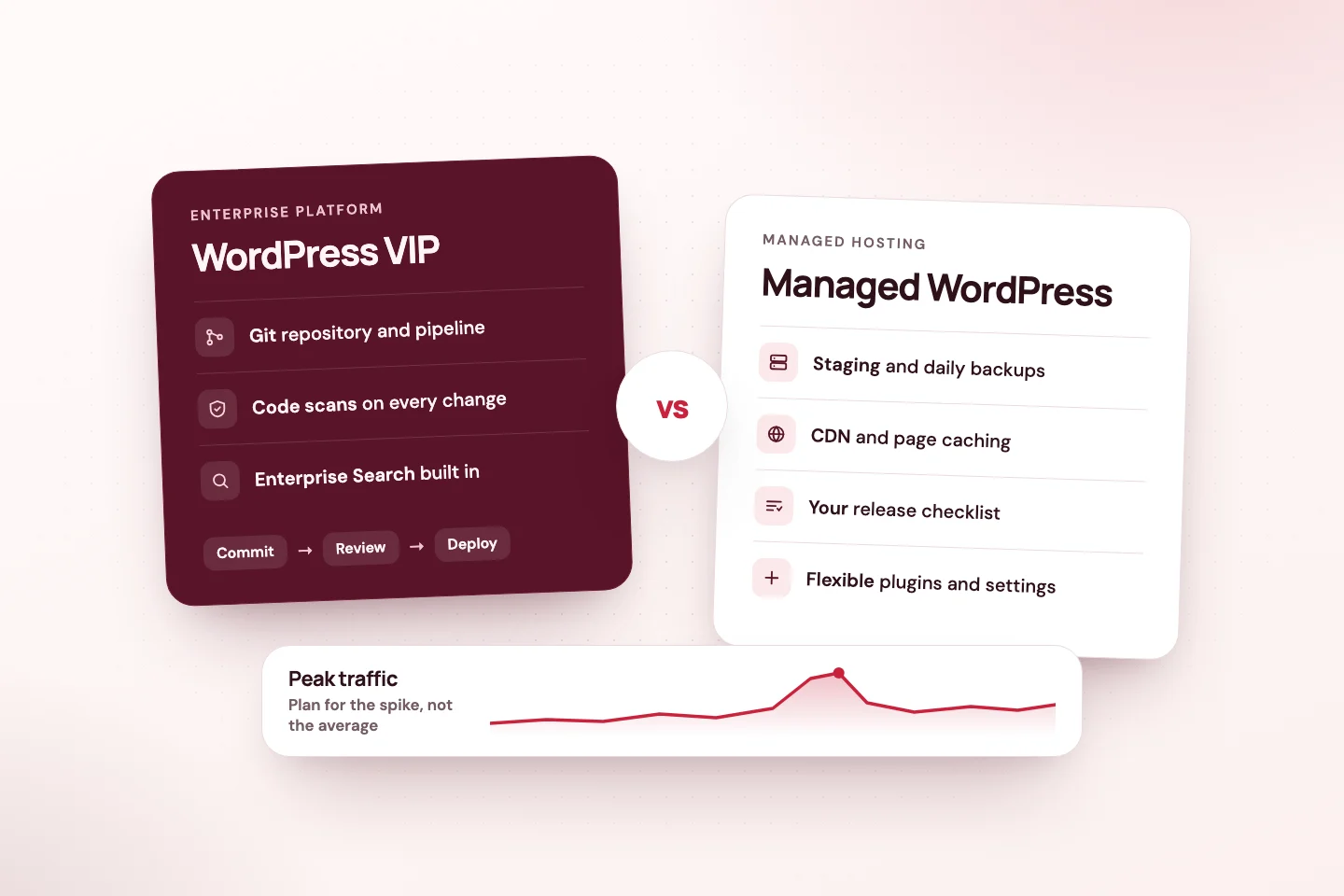
WordPress VIP is an enterprise platform run by Automattic. It is not simply a faster version of a normal host. It changes how you build and release. Code lives in a Git repository and reaches production through a deployment pipeline rather than through plugin uploads in wp-admin. Changes are scanned against the platform’s coding standards, and VIP provides its own page caching, object caching, media handling and an Enterprise Search option.
That structure is the point. It suits organisations that want every production change to be reviewable, repeatable and supported under a contract. It also means some familiar habits stop working. Installing a plugin from the dashboard, editing theme files on the server or writing files outside the uploads system are replaced by repository changes and platform-approved approaches. Confirm the current details in VIP’s own documentation before you plan around them, because platform features change over time.
Know what good managed hosting already covers
A capable managed WordPress host already handles a lot: server maintenance, automatic backups, staging environments, a CDN, page caching and often a web application firewall. Many offer Git-based deployment, SSH and WP-CLI access, and higher tiers with dedicated resources. For a corporate website, a lead-generation site or a busy content site, that is frequently enough.
The difference is usually enforcement and accountability. On most managed hosts, an administrator can still install any plugin, and code quality depends on your team’s own process. If your developers already work through pull requests, staging and a tested release process, a managed host gives you much of the reliability without the platform constraints or an enterprise contract.
Compare the platforms by responsibility
| Area | WordPress VIP | Managed WordPress hosting |
|---|---|---|
| How code reaches production | Git repository and deployment pipeline. Dashboard plugin installs are not the normal route. | Varies: dashboard installs, SFTP, or Git deployment if your team sets it up. |
| Code quality checks | Automated scans against platform standards on each change. | Your team’s own review process and any tooling you add. |
| Traffic spikes | Platform-level caching and scaling built for high-traffic publishers and enterprises. | Depends on the plan. Dedicated or auto-scaling tiers exist at higher prices. |
| Site search | Enterprise Search option built into the platform. | Default WordPress search, a plugin or a third-party service you integrate. |
| Support | Enterprise support agreement covering the platform. | Hosting support. Application issues usually stay with your developer. |
| Flexibility | Shaped by platform rules and approved approaches. | Broad, including plugins and the server settings the host allows. |
Treat this as a starting point for vendor conversations rather than a feature list. The details depend on the plan and contract you negotiate.
Look for the signals that point towards VIP
VIP tends to justify its cost when several of these are true at the same time:
- Peak traffic is large and unpredictable, such as breaking news, product launches or live events, and an outage has a measurable cost.
- Security, legal or procurement teams require documented change control, a support contract and evidence of how code is reviewed.
- Several development teams or agencies contribute code, and you need one standard that does not depend on a single team’s discipline.
- The editorial operation is large: many authors, frequent publishing and search that must stay fast across a big archive.
- You are consolidating several sites or brands and want one governed platform instead of many separately managed installs. If that is the driver, also compare Multisite against separate websites.
If only one of these applies, a well-run managed host with a disciplined release process may be the better investment.
Check how your current site would fit
Before comparing quotes, audit the codebase you already have. List every plugin and note which ones write to the file system, run heavy scheduled jobs, call external services on every page load or depend on server-level configuration. On a governed platform, those are the items most likely to need replacing, refactoring as custom plugin code or an approved alternative.
Consider a fictional publisher with 40 active plugins. Most are fine. Three write cache files to disk, one generates PDFs on the server and the theme queries uncached post meta on every archive page. None of that is unusual on managed hosting, but each item becomes migration work on a stricter platform. Finding them early turns a vague estimate into a scoped list of changes.
Also review how editors work today. Custom blocks, scheduled publishing, previews, user roles and integrations with your CRM or analytics should all be tested on the new platform rather than assumed.
Budget for the whole move, not just the platform fee
Platform pricing is only part of the cost. A move to VIP usually involves repository setup, code changes to meet platform standards, content and media migration, search configuration, testing and a planned cut-over. Moving to a stronger managed host can be a smaller project, but it still needs staging, DNS planning and a performance check after launch.
Give each option the same scenario: your real plugin list, your traffic profile and your editorial workflow. Then compare the total for the first year, including development time, rather than the monthly hosting figure alone.
Common questions
Is WordPress VIP faster than managed hosting?
Not automatically. A well-cached site on a good managed host can be very fast. VIP’s advantage is consistency under heavy, unpredictable load and the guard rails that stop slow code reaching production.
Can we keep our page builder on VIP?
Check it against the platform’s current requirements and test it with your real content before committing. Ask specifically how the builder stores its data and generated files, because that decides how much adaptation it needs.
Do we need VIP for compliance?
Compliance comes from your processes, contracts and controls, not from a hosting brand. VIP can make some evidence easier to produce, but a managed host with documented change control can also support an audit. Ask your compliance team which evidence they actually need.
Send a short platform brief
Share your current hosting setup, monthly traffic and peak events, your plugin list, the number of editors and the integrations that must keep working. I can review the fit, identify the code that would need to change and help you compare WordPress VIP with managed hosting on the same terms.